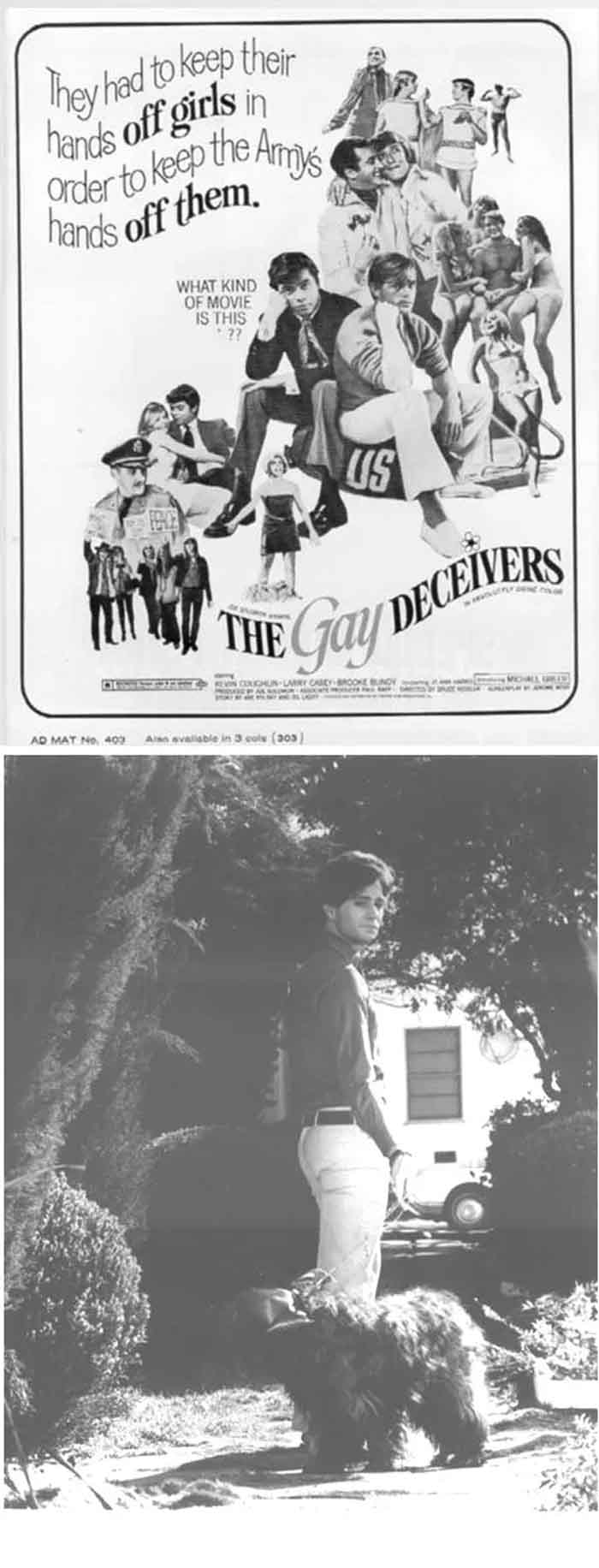
TOM LISANTI INTERVIEWS CHRISTOPHER RIORDAN ON "THE GAY DECEIVERS"
Gays are always fashionably late, and I am no exception, as I pay tribute to that cult classic The Gay Deceivers long after Gay Pride month as come and gone. Released in 1969, this daring-for-its time comedy starred boyish Kevin Coughlin as Danny a preppy 22 year-old with a steady girlfriend (Brooke Bundy) and handsome Larry Casey as Elliot a ladies man and lifeguard who get drafted.
To avoid being sent to Vietnam, the friends pretend to be lovers who desperately want to serve their country. Their ruse works and they are denied entry but knowing the army officer (Jack Starrett) at the draft board will be watching, the duo shack up in a one bedroom apartment in a swinging gay complex and try to convince their landlord Malcolm (Michael Greer), his partner (Sebastian Brook), and the resident stud (Christopher Riordan) that they are homosexuals while keeping Danny's family and Elliot's paramours in the dark. But things get thorny especially when Elliot, at the landlord's costume party, takes a woman to bed not realizing it's a guy in drag. A frustrated drunken Elliot then starts a fight in a gay bar, which is witnessed by Danny and his unsuspecting girlfriend leading to further complications and a surprise ending.
Viewing the film nowadays, The Gay Deceivers (produced by Joe Solomon and directed by Bruce Kessler) is a bit dated with stereotypical gay characters and plays like an elongated episode of Love, American Style. But in its time this was very daring and trail blazing. Director Bruce Kessler takes a sincere approach and knows his audience even giving them glimpses of blonde Larry Casey's fine naked behind. With the hubbub today about gay marriage, it is quite surprising that for a movie made in the late Sixties Greer and Brook"s relationship is treated respectfully and not poked fun at. They come off as the typical wacky married next-door-neighbors found on any TV sitcom at the time. Even the gay bar scene is toned down and not played over-the-top. The actors all do a surprisingly good job but Greer's flamboyant queen act becomes tiresome after about five minutes.
Actor Christopher Riordan who plays Duane was a busy dancing actor throughout the Sixties. A single father, he took job after job to earn a living to support his son.
Extremely handsome with an All-American look and persona, Riordan appeared in practically every beach and Elvis movie from 1964 through 1967 while juggling bit roles in big budget studio productions and TV shows. The widely varied films he worked on during this period include Viva Las Vegas, My Fair Lady, Get Yourself a College Girl, A Swingin' Summer, The Girls on the Beach, Von Ryan's Express, Ski Party, The Loved One, Tickle Me, The Glory Guys, How to Stuff a Wild Bikini, Village of the Giants, Made in Paris, The Glass Bottom Boat, Hot Rods to Hell, Thoroughly Modern Millie, Clambake, and Camelot. His dancing prowess got him noticed especially when Fred Astaire hand picked him to dance with Barrie Chase on TV's The Hollywood Palace. This led Christopher to being also being hired as assistant choreographer on a number of movies. However, as was the way back then, he rarely received screen credit though he finally got on-screen recognition for Fireball 500.
By the late Sixties, Riordan had outlasted a number of the dancing beach boys and directors began casting him in bigger roles due to his talent and professionalism. The Gay Deceivers in 1969 was the first followed by Beyond the Valley of the Dolls and The Curious Female. Christopher is still working today. Most recently, he made guest appearances on the TV comedies House of Carters and Ugly Betty and performs his cabaret act at AIDS benefits in the Los Angeles area.
How did you get cast in The Gay Deceivers?
Bruce Kessler originally had me in mind for Larry Casey's part. In those days, I was very buff. I shocked everyone when I opted for the part of Duane.
Why did you choose the smaller supporting role over the lead?
Even after my agent described the part of the lifeguard, I thought it was boring; and that was before even being able to read any of the 'sides'. I had spent so many years in a bathing suit, in all those AIP beach party movies that I just didn't see any fulfillment in playing that part. I also knew that there were many actors in consideration for it. That is, until it became known what the movie was about. Indeed, a lot of actors shied away from this script.Also, I had always considered myself to be a 'character actor.' I didn't enjoy playing the 'handsome leading man.' For one thing, I never considered myself that handsome. Now, when I look at old pictures, or films, I say to myself, "Oh, that kid was pretty good looking.' Now, I understand why they were always trying to put me into that 'boring' category.
What was Bruce Kessler's reaction?
He was shocked and I don't think he was going for it. So I went home, did some shopping, and returned to his office the next day or so. Bruce took one look at me, and seemed astonished at the transformation. He then said, "If you really want it, then that part [of Duane] is yours.' My thinking was, and I was right; that this role would be a stand out-Duane and Malcolm would be the parts that one remembers.
Do you think the producer and director treated the material respectfully?
Joe Solomon was a real character-typical producer. I'm sure he was exploiting the whole idea. Bruce Kessler, on the other hand, took all of this very seriously and really wanted to do a good film. He ended up as one of my favorite directors.
Why did Bruce Kessler impress you so?
Because it was how well Bruce, the crew, etc. were treating me. They seemed to respect the years of experience that I brought to the table. I recall Bruce applauding when I made my entrance. It was my first shot. I told him, "I have an idea....' He said, "Good, do it. Don't tell me, I'll go along.' Obviously, I brought a lot more to the part than what was written on the page. But I also wanted to be very careful [with my performance], as I knew, one day, my son would see this movie. Bruce was so thrilled at my delivery that he called my agent and told her, "I'm giving Christopher single card billing along with the leads.' She was excited at that, and frankly, so was I.
Did Kevin Coughlin or Larry Casey show any reservations about taking the lead roles?
Kevin was a really lovely guy. He too, took it all very seriously, and wanted to do a good film. I'll never understand why Larry took the part. He was truly spooked the entire time.
How so?
I'm sure Larry Casey is/was a very nice man. I know he was a husband and a father, and that he had been a regular on The Rat Patrol. In his defense, as I mentioned, I thought his part was very dull and I don't think he had the charisma, or the understanding, to pull it off. Throughout the entire shoot he seemed to be drowning. I felt that nothing he did actually connected. I know that Kevin was always trying to work on their scenes together, but Casey never picked up the subtle hints. I hate to say it, but I don't think I ever worked with an actor that I got less from, than Larry Casey. A life-size photo might have been more affective. It was painful, during the party scene. So much more could have been done with that.
What do you recall about Michael Greer who played the one of the landlords?
This was the second of three films I did with Michael who was openly gay. He loved what I was doing with my role, and stole my adlib of "Miss Thing" for his act-and, ever after, I think. We were encouraged to add things if we thought they might work. However, Michael tended to 'take over' the directing of some scenes especially the party scene moving people around and giving them bits of business. In regards to Casey, I recall him rolling his eyes and muttering, "Where did they find this guy?' He even said to me, "You poor thing-you have to act like you're attracted to him.' Michael was very direct.
I don't think he and Bruce Kessler ended up on the best of terms. Michael was definitely trying to make his mark and he did offend some people. Not me though, until about five years later, during one of his live performances. He introduced every one of his actor friends in the audience except me. I kept thinking, "Oh, he's saving me for last.' He wasn't. I just shrugged his slight off.
Do you recall the reaction of the fans when the movie was released? It was a box office hit.
Indeed, I was at the premiere. Somewhere, I have a shot of the huge line, going all around the block, lining up to see this film. My entrance got a huge hand, with much shouting and foot stomping. I think it let the audience know it was all OK to laugh at all of this. I was then only offered the same kind of roles for ages. In fact, Dominick Dunne and I had a bit of a fight over my turning down a part of a hustler in his movie, Play It as It Lays.
They brought the movie back every summer for a few years. Then, it seemed to disappear. It was ages before it became available on video. By the way, I was also told that the rental prints (16mm) often came back with my entrance, and my billing, missing-sort of 'early days of Rewind', no? It got so that they had to run the film when it was returned. If those scenes were excised, the customer was told to either return the missing footage, or pay.
Tom Lisanti / www.sixtiescinema.com
NOTE: This was originally published on July 30, 2008 at: https://www.cinemaretro.com/index.php?/archives/2228-TOM-LISANTI-INTERVIEWS-CHRISTOPHER-RIORDAN-ON-THE-GAY-DECEIVERS.html
A friend had read the book and said it was wonderful. So, I read it. I heard never heard of Jacqueline Susann before. The book was all about pills and in those days, pills were the thing. There was talk that my name was being put forward to play the singer, Tony Polar.
What was your experience of the world of casting and moviemaking in the mid-to-late ‘60s?
At the time of Valley of the Dolls, I was fortunate to have a very fine agent -- such a gentleman, always beautifully-dressed in a suit. He was an agent who didn’t just send you to see casting directors, which is like saying a used car salesman. He would call and invite me to lunch at the 20th Century Fox commissary, the nicest commissary of all the studios, with beautiful white table linens, and wonderful murals on the walls.
All the producers and directors would walk by our table and they all knew Leon who’d been in the business since the ‘30s. He’d say, ‘You know my client Christopher Riordan, don’t you? I’m sure you’ve seen him in this movie or that. Well, we’re here today because he’s up for this role in this movie.’
It almost made it seem like we were not there for business deals, we were not there to put ‘the touch’ on anybody – of course, in fact, we were. He made it seem so elegant and gracious and did it with such panache and style. I seldom ever went through a casting agent.
In memory, Joe Scully and all of those casting men at 20th and other studios seemed to look alike. Most casting directors are rather boring people. I always thought of them as people who wanted to become actors but knew they had no talent, so they thought they would find it in others.
I thought Ray Stricklyn, a brilliant talent, went in to read for one of the roles. [Note: Stricklyn was seen for the role of Ted Casablanca]. He was a brilliant talent. I worked with him on Somebody Up There Likes Me and thought he was like such an older talent in a young body. That’s what prevented him from becoming a big star.
Then North Frederick really should have made him big. Anyway, there was talk about my playing the singer Tony Polar in Valley of the Dolls but that didn’t happen. I was too young for it – looked too young for it.
So, Tony Scotti got cast as Tony Polar but that didn’t end of your connection with Valley. But I’d like to hear what you remember about 20th Century Fox in those days.
Very busy, lots of energy. Some of the offices at 20th were grand and quite nice, well done by some interior decorator. I mean, you can’t imagine that Darryl Zanuck’s office would be decorated by Darryl Zanuck himself? Yet even some of the top producers and writers had little cubbyholes, just bare, utilitarian and spare. I’d see them and think, How can anyone can anyone be inspired by working in this room? I did Beyond the Valley of the Dolls I can’t even tell you how ugly Russ Myer’s office was. Incidentally, Russ Meyer was one of the most wonderful directors I ever worked with. He had great respect for actors. Nothing was too small or ‘unimportant’ for him to give his complete attention. I really appreciated that. He was really a lovely man and I liked him a lot. And mind you, I’m saying this as someone who didn’t want to be in that sequel to Valley of the Dolls and who certainly didn’t want to be playing a character listed today by IMDB as “Gay Boy.”
Did you have much or any interaction with studio heads Darryl F. or Richard D. Zanuck?
Darryl Zanuck was everything anybody ever said. I heard the stories through Marilyn Monroe. He was awful, just a lech – a horrible man. He chased every woman around the desk, which is something I heard all the time from so many actresses. It sounds like a Hollywood cliché but it happened. I thought Richard Zanuck was a gentleman. He had learned how to behave himself. I never had much to do with him, except for social niceties. But I always heard that for the most part, he handled himself professionally.
What did you think of Valley of the Dolls when you saw it?
I saw it with friends in Hollywood at Grauman’s Chinese Theater around Christmas of 1967. My fascination with the movie had been about Judy Garland’s involvement and her having been replaced by Susan Hayward. I had a friend named Wayne Martin, whom Judy called her ‘number one fan.’ He had everything on Judy – eyelashes, pictures, stockings, everything. When you went to his house, there was a yellow brick road. He was the man responsible for my being able to go to every single rehearsal and taping of the Judy Garland television show. When I visited Wayne, Judy would call him and he’d motion for me to pick up the extension. Sometimes, he’d say, "Judy, a mutual friend is here." What I didn’t hear personally about Valley of the Dolls from Wayne while Judy was making it, he had taped. It’s well known that he taped his conversations with her.
What did you hear via those tapes and what did Wayne Martin tell you?
They would deliver Liebfraumilch to the studio by the ton. In those days, I didn’t think they thought that was doing her all that much harm. There were so many other things going on with poor Judy that Liebfraumilch was to be the thing that would do her in.
With Valley of the Dolls, I heard all of it – from Judy’s saying, "I’m up for the part to I got the part to I’m so excited," to "Things didn’t go so well today," to "Oh, that director is just awful. I really don’t think he likes me." It went from one extreme to the other until she called Wayne and I was there when she did.
She had this horrible, heartbreaking tremor in her voice and she said, "I’ve been FIRED!" My God, it was awful. The first thing we thought of is, I hope there isn’t any wine in the house. I went through all of that. It was a very sad time. Everybody had thought that Valley of the Dolls was going to be yet another great comeback for her, like A Star Is Born. It was awful. The director seemed to have a real hate for her, for some reason. If he felt that way, why in the world did he even hire her? I don’t know if the studio forced her on him or if he felt that way but it was a sad thing for Judy that affected her greatly.
Being in the business, you had to have heard a lot about 20th’s plans to make a sequel to the massively successful Valley of the Dolls?
Oh, yes. I had made a film called The Gay Deceivers and Leon had taken me to 20th knowing particularly that two of the films that were being prepared at the time were the Valley of the Dolls sequel and Myra Breckenridge. So, I was first brought in to be interviewed by (Myra) Michael Sarne, Mae West, and Bob Fryer, who was the producer. I found Michael Sarne childlike and out of it. Of course, I found out later that he was totally stoned on grass. Plus, as much as I love Miss West’s presence on screen, she was not the most charming lady in person. I remember Mae West saying to somebody, referring to but not addressing me, "Ask him if he’ll cut his hair." I thought, 'If you can’t ask me yourself ...'
The only other person I ever met like that was Cyd Charisse, a magnificent dancer and both Fred [Astaire] and Gene Kelly adored working with her – as a dancer. The choreographer Bob Sidney asked if I wanted to audition to dance in a European tour of an act Cyd Charisse and Tony Martin were putting together. That sounded wonderful, but Bob told me, "Cyd and Tony will never talk to you. They don’t address you. They send messages through somebody else." I said, "So if she steps on my foot, what do I do, send her a telegram?" But, listen, if you said hello to Cyd Charisse at a party, she was stuck for an answer. She wasn’t great. Bob was shocked when I turned down the chance to go to Europe with Tony Martin and Cyd Charisse. After meeting Michael Sarne and Mae West, I thought, 'I don’t think I want to do this. I’ll take the other one instead of Myra Breckenridge.' We were given a script and I had two weeks to learn it.
As you know, Bob Sidney choreographed Valley of the Dolls. What sort of man was he?
I actually didn’t know that. Bob Sidney could be very cruel, very nasty. Among dancers and actors, he was often called ‘Evil Mary.’ When I saw Susan Hayward doing I’ll Plant My Own Tree, I thought, 'Good god, who choreographed this number?' Awful! Susan Hayward is one of my great favorites, in my top five Hollywood beauties of all time, and here’s that mobile hanging over her head and her making those lurching steps? Just dreadful, really terrible. Well, now I learn it was Bob Sidney – “Evil Mary” himself.
Do you remember any specifics of that Beyond the Valley … screenplay?
I don’t really, it’s so long ago. Anyway, I took that one, signed the contract, and they said they’d be back to us on the start date and all of that. Since there was time, it was a perfect chance to go to Mexico, which is something I do whenever I get a chance. I took the script on vacation but by the time I came back, that horrible incident [the murder of Sharon Tate and her friends by members of the Manson cult] had occurred. That’s when they told us that there was going to be a delay and I couldn’t understand why that incident was going to have an effect on the sequel to Valley of the Dolls.
Little did I know that that whole horrible incident would have such an effect on everything, even on the sequel to Valley of the Dolls. I didn’t know then that Roger Ebert had been brought on to change the script – considerably, as it had turned out. Had I not already signed my contract, I would have said no to that script. I remember going to the premiere and saying to my date, “Well, this is the end of my career.” I embrace the movie more now. I get a lot of letters from people who go to midnight showings and one of their favorite exchanges of dialogue in that film is “You’re a moonchild!” and me saying, “And you’re a bitch!”
Did you know or socialize any of the people who were involved in making Valley of the Dolls?
Sharon [Tate] I met at Metro and that horrible house in which she and the others lost their lives was just across the courtyard from El Cielo near Falcon Lair, which was Rudolph Valentino’s old home, where I lived. I was probably closest to Barbara (Parkins] because, before and after she was making Valley, I used to see her all the time at Cass Elliot’s house. I worked with [Barbara] on Peyton Place, too.
What were your impressions of her?
She was a very headstrong girl. Aggressive. I don’t like to throw compliments my way but I think she was after me. She made no bones about it which, to me, is not terribly attractive. She was strong and a little too pushy for me. A gorgeous girl and I loved her voice but I just wasn’t interested. She didn’t take it very well at all. She was used to getting her own way. You can’t blame her for thinking at the time, ‘Hey, I’m pretty hot stuff and this guy’s just a bit player. So, why is he not acquiescing and falling all over me?’ It was difficult anyway because Mama Cass was after me. This sounds very strange, doesn’t it? I was raising my young son my myself and she was raising her daughter by herself and I think she thought, ‘Oh, here’s a man that knows about babies.’
Cass Elliot’s parties were legendary for many reasons. The availability of drugs being one.
I observed a lot of that in Hollywood. I was so innocent and, probably, stupid that I’d see people excuse themselves from the dinner table and keep going to the bathroom and think, Do they have a urinary problem? I was naïve and maybe dumb. I certainly witnessed it but never around the lot. I didn’t even smoke cigarettes, except for roles. I did a stage play called Rope and had to smoke all the way through it. The last curtain rang down and I never wanted another one. Having the discipline of a dancer, there is no way I was going to get involved with any of that – although I have known dancers who did and their careers were short-lived. It just wasn’t anything I wanted to partake in. I wasn’t interested. I could have a lot of fun on 7-Up and a coffee table to dance on. I never even had cocktails at cocktail hour except when I moved to Mexico and it was because, ‘Well, I have to do this, otherwise, some of these people are going to bore me to death.’
You’ve appeared on several seasons of the TV show Superstore. What do you miss about ‘Old Hollywood’?
Today, I ask myself, ‘Whatever happened to the pretty people?’ When I first came to Los Angeles in early 1956, everyone was either absolutely gorgeous or they looked like either Percy Kilbride or Marjory Main, which was another perfectly acceptable category. But everybody looked interesting. Nowadays, I’ll see one of the new young actresses on the lot when we’re working and I’ll ask one of the kids on the show Which one is that? I say, ‘Well, they all look they came out of some cookie cutter. They all have that sort of dumb look and they all sound alike. It’s all, ‘So, he goes, What do mean? And I’m like, No, what do you mean? And’s he’s all like …’ I can’t. I walk away.’ It’s certainly not like talking to Elizabeth Taylor, that’s for sure.
-Tom Lisanti / www.sixtiescinema.com